A walk-in cooler that will not hold temperature almost always has one of six problems: warm product loading, a door that is not sealing, an iced-over evaporator coil, blocked airflow inside the box, a dirty condenser, or a refrigerant leak. The first four are things you can check yourself in about fifteen minutes. This guide walks through them in the order a technician would, starting with the checks that cost nothing.
The stakes are simple. A walk-in cooler should hold product between 35 and 38 degrees Fahrenheit, and food safety rules draw the line at 41. Once the box drifts above that, the clock starts on everything inside it. Work through these checks quickly, and if the temperature keeps climbing, move product to another unit while you figure it out.
First, confirm the reading is real
Before chasing a mechanical problem, make sure there is one. Wall-mounted dial thermometers drift out of calibration, and digital displays read whatever their sensor sees, which is not always what your product sees.
- Put an independent thermometer in a glass of water on a middle shelf and check it after 20 minutes. Air temperature swings fast; product temperature is what matters.
- Note where the display sensor sits. A probe mounted near the door reads warm every time someone walks in. One mounted in the evaporator airstream reads colder than the product.
- Check the temperature at different times. A box that reads 44 right after the lunch delivery and 36 at 3 pm is recovering normally, not failing.
Check how the cooler is being used
A surprising share of warm walk-in calls end with no repair at all. A walk-in is designed to hold cold product cold, not to pull a pallet of 70-degree deliveries down to 38 in an hour. If staff loaded a large warm delivery, the box may just need time.
Doors are the other usage problem. A door propped open during a delivery dumps the cold air out in minutes, and in Florida it also pulls in humid air that ends up as frost on the coil. If the temperature complaint lines up with delivery mornings or a busy service, watch the door before you blame the equipment.
Inspect the door, gaskets and hinges
With the door closed, look for daylight around the frame and feel for cold air escaping at the edges. Door gaskets tear, flatten and harden with age, and a sagging hinge can hold one corner of the door off its seal permanently. Close the door on a piece of paper: if it slides out with no resistance, the gasket is not sealing at that spot.
Check the strip curtains too, if the cooler has them. Missing or taped-back strips let warm air pour in on every entry. None of these parts are expensive, and replacing a gasket is one of the cheapest repairs in commercial refrigeration, but a leaking door makes the whole system run longer, ice up faster and die younger.
Look at the evaporator coil for ice
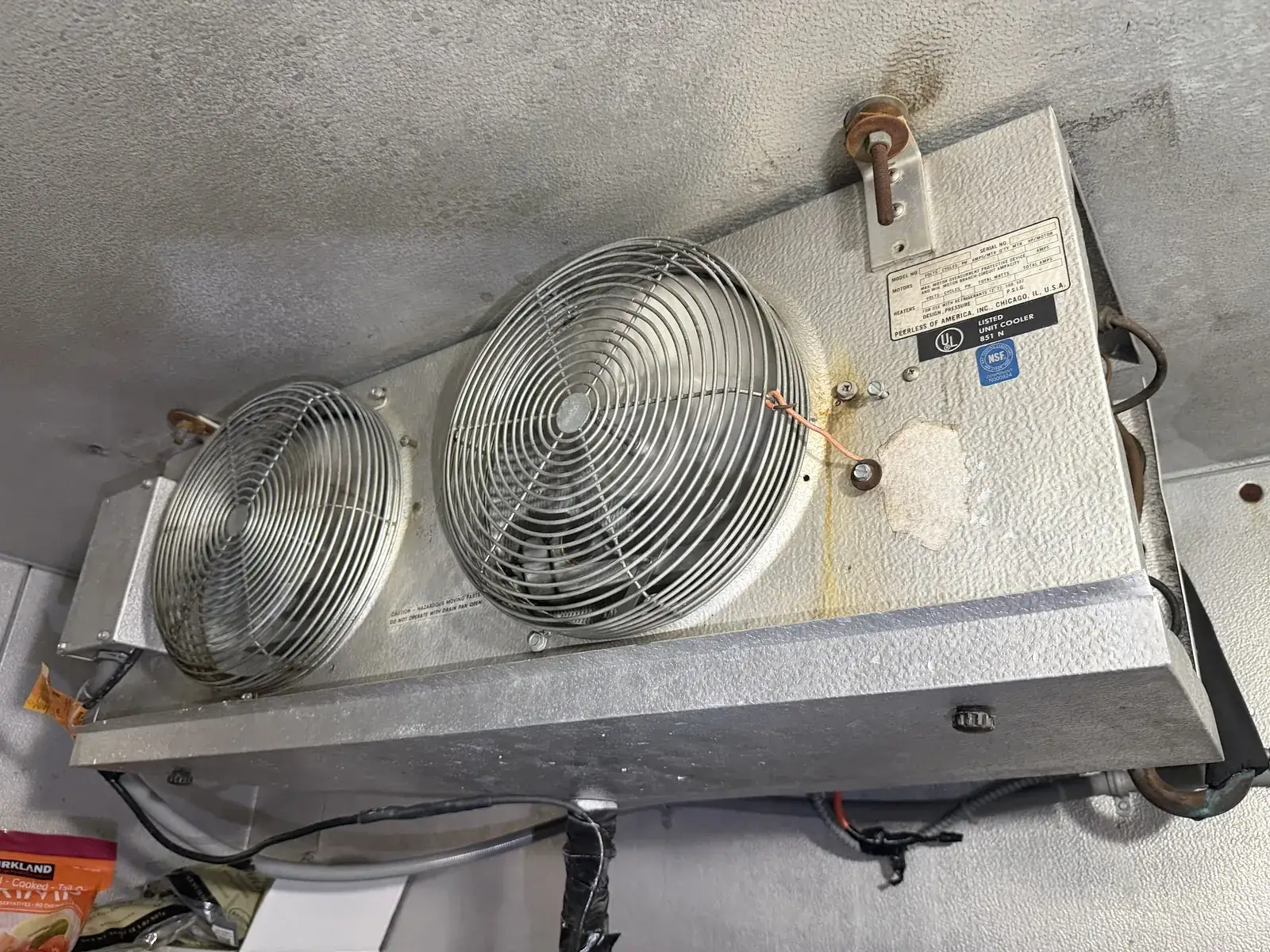
Open the box and look at the evaporator, the finned unit with fans mounted inside, usually on the ceiling. It should look frosted at most, with air moving freely through it. If it is buried in a block of ice, the cooler cannot absorb heat no matter how hard the compressor works, and the air coming off the fans will feel weak and warm.
An iced coil is a symptom, not a diagnosis. The cause is usually a failed defrost heater, a stuck defrost timer, a door leaking humid air, or low refrigerant. You can thaw the coil by shutting the unit down and letting the ice melt, never by chipping at it, because the fins and tubing bend and puncture easily. If the ice comes back within a day or two, the underlying fault is still there and it is time for a diagnosis.
Clear the airflow inside the box
Evaporator fans need to pull air across the coil and throw it the length of the box. Boxes stacked to the ceiling in front of the unit, or product pushed tight against the back wall, short-circuit that airflow and create warm pockets that never see cold air. Keep a clear path around the evaporator and space between product and the walls, and confirm every fan blade is actually spinning. A dead fan motor halves the airflow and is a quick, inexpensive swap.
Give the condensing unit room to breathe
The condensing unit, outside or on the roof, is where the heat removed from the box gets dumped. A condenser coil matted with dust, grease or cottonwood fluff cannot reject heat, so pressures climb, capacity drops and the compressor runs hot. Look at the coil: if you cannot see metal fins through the dirt, it needs cleaning. Clear leaves and vegetation around outdoor units and make sure nothing has been stacked against them.
Signs it is a refrigerant or mechanical problem
If the door seals, the coil is clean and clear of ice, airflow is good and the box is still warm, the fault is likely in the sealed system or controls. Clues that point that way:
- The compressor runs constantly but the box never reaches setpoint.
- The compressor short-cycles: starts, runs briefly, clicks off, repeats.
- Oil stains on refrigerant lines or fittings, which usually mark a leak.
- Frost on the suction line or on just part of the evaporator coil.
- A hissing or gurgling sound at the evaporator.
These are not do-it-yourself territory. Refrigerant work requires EPA certification, recovery equipment and gauges, and topping off a leaking system without fixing the leak just schedules the next failure.
When to call a professional
Call when product is at risk, when the quick checks above do not bring the box back below 41 degrees, or when the same symptom keeps returning. Doctor Fridge handles walk-in cooler and freezer repair across Sarasota, Manatee and Charlotte counties, with same-day service available. The commercial service call is $150, you get an honest diagnosis, and the repair is quoted before any work begins. We fix walk-ins far more often than we condemn them, because repair first is the whole point of the practice. Florida license CAC1815692.